Strong yet Controllable LLM Abstention
without Learning to Abstain
1 State Key Laboratory of AI Safety, Institute of Computing Technology, CAS
2 University of Chinese Academy of Sciences 3 Beijing Institute of Technology
01 / TWO ROUTES
Two distinct abstention paradigms.
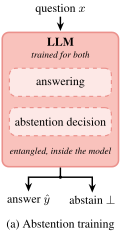
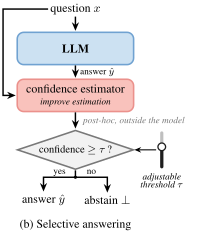
Declining to answer is a simple way to avoid a likely hallucination. The design question is who makes the call. Abstention training teaches the model itself to output either an answer or a refusal such as “I don’t know.” Selective answering lets the model answer first; an external confidence estimator then keeps or withholds that answer.
02 / THE TRADE-OFF
Abstention training sacrifices controllability for performance.
Abstention trades quantity for quality. The standard risk–coverage formulation tracks quantity with coverage, the share of questions answered, and quality with risk, the error rate among those answers. A better method achieves lower risk at matched coverage (Risk@Cov). We compare TruthRL, a state-of-the-art abstention-training method, with selective answering that uses a strong confidence estimator (S.E.).
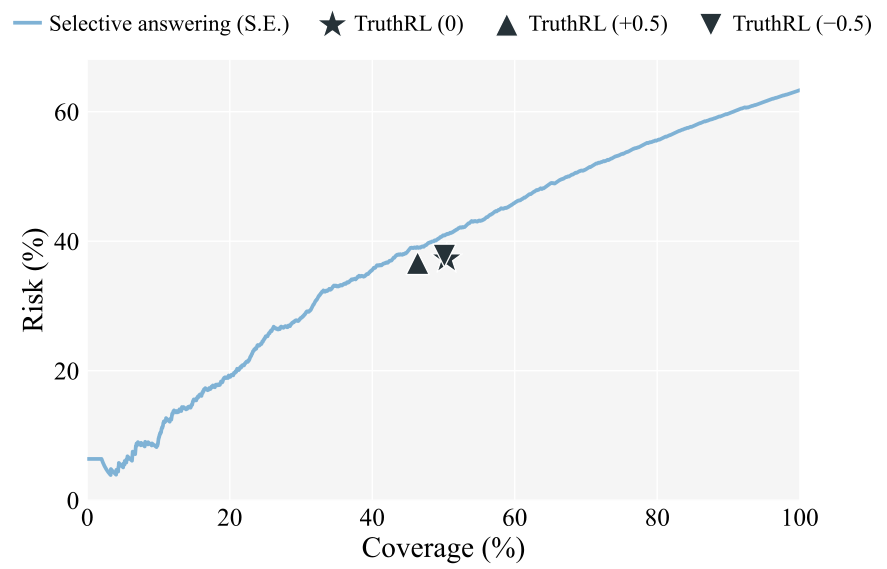
Better performance. TruthRL achieves lower risk at matched coverage.
Less control. Selective answering changes coverage by turning a threshold. In contrast, a trained policy can only move by retraining, and even separate runs with different abstention rewards tend to cluster in a narrow coverage range.
Can abstention be both strong and controllable?
03 / THE KEY FINDING
The performance advantage comes from better answers, not better rejection.
We analyze where the advantage of abstention training comes from. At a fixed coverage c, risk r(c) can fall in only two ways: the model answers better (fixing more answers than training breaks) or rejects better (withholding answers that would have been wrong). It is like grading a student who may skip questions on an exam: a higher score means they either learned more or skipped more wisely. We split risk exactly into these two parts: the net accuracy gain, Gans, and rejection precision, Gdis, the share of withheld answers that would have been wrong.
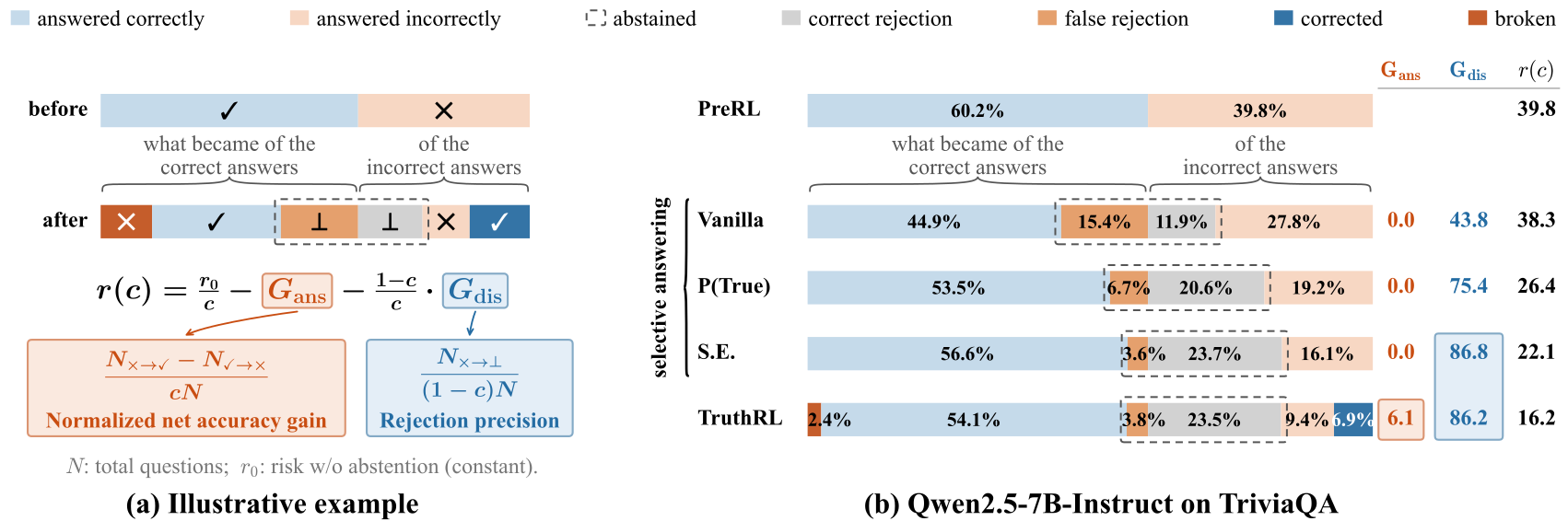
A stronger selector closes the rejection gap fast. Across nine model–dataset settings, mean rejection precision of selective answering rises from 59.47% with Vanilla confidence to 74.84% with P(True) and 84.64% with semantic entropy, essentially level with TruthRL’s 84.29%. TruthRL’s answering gain, meanwhile, is positive in every single setting. Despite its name, then, what sets abstention training apart from strong selective answering is mostly how well it answers, rather than how well it abstains.
What if selective answering had an equally strong answerer?
04 / THE RECIPE
So: Train for Accuracy, then Post-hoc Select (TAPS).
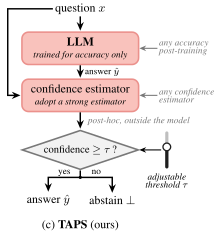
TAPS (Train for Accuracy, then Post-hoc Select) enhances selective answering by strengthening the answerer, then leaves the abstention decision to the external estimator.
STAGE 1 · TRAIN FOR ACCURACY
Improve answers with ordinary post-training. We use GRPO with a common outcome reward: +1 for a correct answer, −1 otherwise. There is no abstention objective anywhere.
STAGE 2 · POST-HOC SELECT
Score each answer with an off-the-shelf confidence estimator, such as semantic entropy or a probe on the model’s hidden states. Keep the answer if its score clears τ; otherwise, abstain.
The answerer stays fixed while τ sets coverage. TAPS simply combines two well-developed research fields through a minimal interface, so it is easy to put into real-world use and can benefit from advances in either field, making it a simple, general, and evolving approach.
05 / PERFORMANCE AND CONTROL
TAPS is competitive with abstention training while keeping coverage adjustable.
We test three LLMs on NQ, PopQA, and TriviaQA in a closed-book setting, with chain-of-thought reasoning. In each setting, TAPS and the abstention-training baselines start from the same model and train on the same data. Each block below sets TAPS to the coverage of one baseline and compares risk.
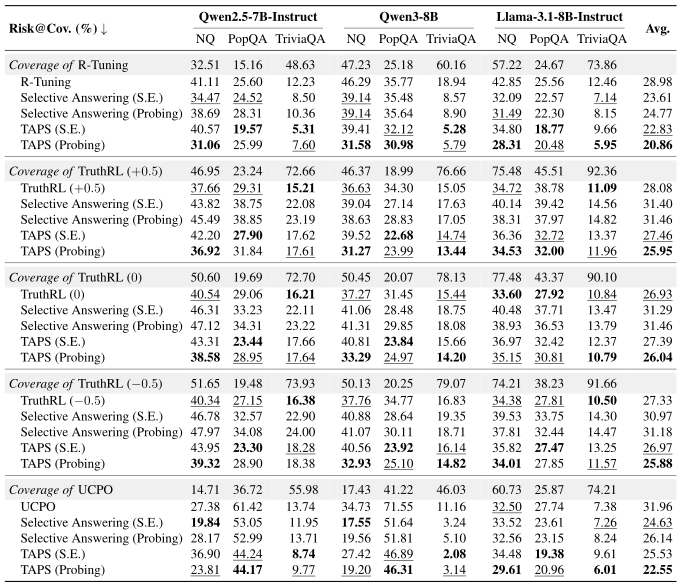
Lower risk. With a probing estimator, TAPS cuts mean risk by 8.12 pp versus R-Tuning and 9.41 pp versus UCPO. Against the stronger TruthRL, it wins 17 of 27 comparisons, with a mean gain of 1.49 pp across three reward settings. The gain is uneven: largest on the reasoning model Qwen3-8B (5.05 pp below TruthRL), roughly on par on the two instruction-tuned models (0.30 pp higher risk), which highlights its promise for native reasoning models.
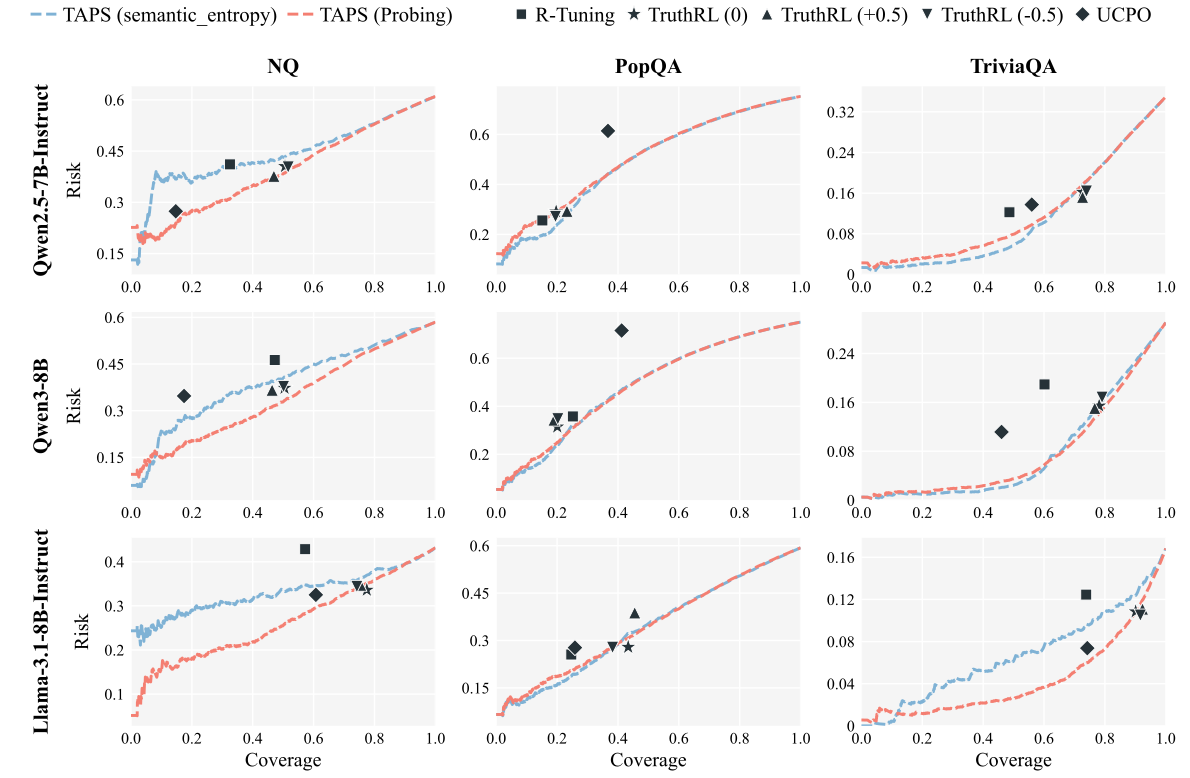
Control, kept. One TAPS answerer plus one estimator covers the whole risk–coverage curve. Three separately trained TruthRL reward variants, by contrast, span less than 5 pp of coverage in eight of nine settings.
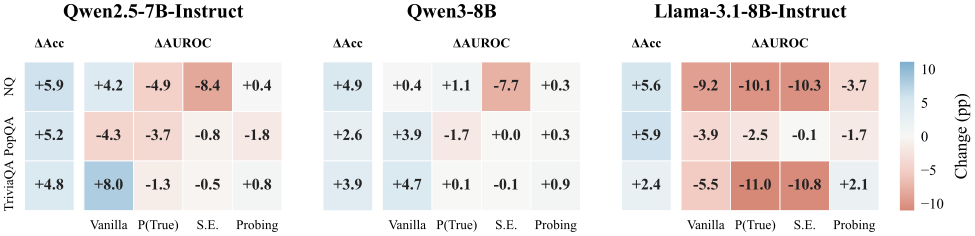
Stage 1 improves answering, but can degrade confidence estimation. Accuracy training lowers risk in 81 of 90 matched-coverage comparisons (3.55 pp on average). It does so by improving the answers: accuracy rises in all nine model–dataset settings, by 2.4–5.9 pp. However, post-training can degrade confidence estimation, potentially lowering rejection precision.
Probing in Stage 2 largely recovers the degradation. Accuracy training damages confidence estimation particularly for the three unsupervised estimators, mainly on Llama. A correctness probe, in contrast, is refit on each checkpoint’s hidden states, allowing it to adapt to the changed representations and largely recover the degradation. Therefore, probing is comparatively stable in the heatmap and gives TAPS its strongest overall results, although the best estimator still depends on the setting.
06 / THE TAKEAWAY
Abstention training wins by answering better.
Risk depends on both how well a model answers and how precisely it rejects wrong answers. A strong post-hoc selector can already match much of abstention training’s rejection precision. Against that selector, abstention training’s remaining advantage comes mainly from better answering, rather than more precise rejection. Improved abstention performance alone does not establish that learning to abstain is what helped.
Internalizing abstention should achieve more than TAPS.
TAPS combines an accuracy-trained answerer with a strong post-hoc selector and retains direct control over coverage. This makes it a more informative baseline for evaluating abstention training. A method that gives up that control should deliver further gains over TAPS, beyond improvements over the model it started from.
  @misc{zhang2026strongcontrollablellmabstention,
  title={Strong yet Controllable LLM Abstention without Learning to Abstain},
  author={Junwei Zhang and Yifei Wang and Wanli Yang and Hexiang Tan and Rui Tang and Xin Chen and Jingang Wang and Du Su and Fei Sun},
  year={2026},
  eprint={2610.16318},
  archivePrefix={arXiv},
  primaryClass={cs.CL},
  url={https://arxiv.org/abs/2610.16318},
  }